Thursday, June 7, 2012

La Cienaga (The Swamp), Parte II


Wealth is a trap. It is not freedom. It is not the path to “the good life.” The American Dream has become a nightmare, a miry pit. It is a swamp. Una cienaga.

Scene from the original "La Cienaga," a 2001 film that depicts a lethargic, self-pitying, bourgeoise Argentinean family. 

SCENE 1: [Overheard.] Rich socialite from Houston: “Oh my gosh it was terrible. We were trying to buy this gorgeous house in the south of France, but the time came and the agent who had arranged the deal took the money and ran. So I flew over straight away with my husband and another couple for a week. We got the French police and the FBI involved, of course! But the French did nothing. He took nearly a quarter of a million. Really terrible.”

SCENE 2: [Overheard.] An unsmiling, 21-year old girl from Santa Barbara, California. daughter of a skinny, bikini-clad divorcee. Unsmiling puts down her iPhone 4 and remarks that she’s glad to be moving to New York (City) instead of back to Cali. “I had to escape. My friends back there, they’re stuck in this weird, like, incestuous bubble. They have more money than they know what to do with.”

SCENE 3: Houston socialite overheard on a canoe excursion. “Wait, you guys don’t have water for us?” Well we will have some hot chocolate, coffee, cranberry juice and other snacks halfway through the tour…“Are you kidding me? Do you know how much alcohol they make us drink on these cruises? And you don’t have water for us? That’s really ridiculous.”

INTERMISSION:
Poverty is a birdcage. Each wire is small and seems surmountable—“if only ‘those people’ would just get off their butts and get a job!” It’s only when you see all the wires together—gangs, poor education, pollution, lack of access to healthy food, media, unemployment, racism, STDs, low expectations, absent fathers, lack of healthcare, unfair criminal justice policies, crumbling houses, teen pregnancy, sexism—it’s when all these wires come together that the bird is trapped. Poverty is a birdcage.

Wealth is a swamp. The ground may look firm, or the water look cool and refreshing. But the deeper you go, the more the mud sucks you in. The lukewarm water creeps ever-higher. You’re trapped in a world of complaining, cynicism, and more food than you could ever eat. Servants surround you, and cater to your desires until your body weakens. In the swamp of wealth, frowns cease, but so do smiles. It of course takes more muscles to frown than to smile, but if your muscles are completely atrophied, you can’t do either!.

I’m twicefold a member of the “1%.” On a global and historical level, I’m a member of the richest humans who have ever lived. Ever. I’m also a recent initiate to the 1% of Americans who have graduated from a liberal arts college. And thus the swamp has never been far from my path. I may try to act as a “traitor to my class” like Warren Buffett, but the temptation is still there. Will I dabble in it? Become an unsmiling (or worse: fake-smiling), sarcastic elite? The swamp scares me because on some level it tantalizes me.

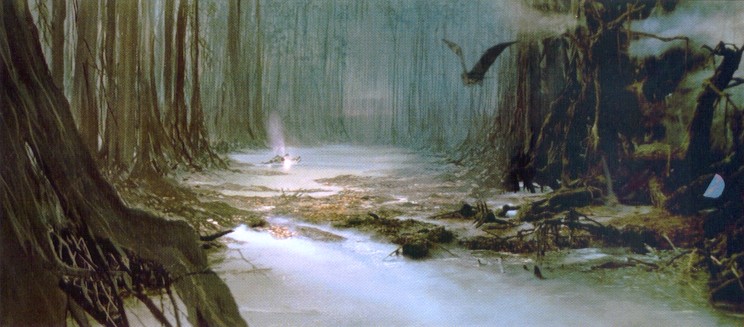
The Dagobah Swamp
SCENE 4: A young man, swamp-moss still clinging to his silk robe, runs through the crowd to the Teacher. He pants, out of breath—tearing himself from the mire had taken enormous effort. Teacher, he says, how do I inherit eternal life? “Ah, you wish to enter into life? Follow the rules: don’t kill or steal or cheat, love your neighbors and parents.” But, the man protests, have I not done all these things? What am I still lacking? The Teacher looks at the ridiculous figure in front of him: pudgy cheeks, designer robe, with mud caked on everything. And the Teacher loves him. With deep tenderness in his voice, the Teacher replies, “If you wish to be complete, go and sell all you possess. Leave your marsh-land and your marsh-palace and instead come, follow me.” The man’s face goes crestfallen. He slowly turns, and instead begins to trudge back to his pit. Once there, he eases himself into the ooze and cries bitterly, for he cannot part with his swamp!

Dénouement:
 “Truly I say to you, it is hard for a rich man to enter the kingdom of God.” A scary sentence if ever I’ve heard one. But maybe it makes sense. I see people around me trapped in the swamp of wealth, and I know that that’s not how God wants it. That’s not life. And if that’s the American dream, to have a big-screen TV, a big empty house, a big Louis Vitton bag, and a big fat entitled attitude to go with it all, then let’s leave the American dream behind. It is a trap; it is a lie.

If anyone, including me, begins to flounder in the swamp of wealth, may he, unlike the young man, have the courage to leave it. He who has ears to hear, let him hear. 

Saturday, March 17, 2012

Anakin Skywalker: Tatooine's Messiah

Star Wars is more than the sum of George Lucas’ films. The symbols, characters, and themes go beyond anything he could have dreamt up, intelligent as he is. They touch on lodestones in the human spirit, the stories that rise up in every religion, every culture, and every generation.

I’ve written elsewhere of Anakin Skywalker, the lynchpin to the whole saga. He is the one who rejects both the strict, unyielding dogmatism of the Jedi and the unrestrained evil of the Sith. He successfully treads the line between moralism and relativism. His ultimate, deepest motivation is love.

I did not make it explicit enough in my previous blog. In many ways, Anakin is like Jesus.

But my previous blog largely used evidence from Episodes 2 and 3; here, with the film fresh in my mind, I shall focus on Episode I: The Phantom Menace. Anakin, like Jesus, is a Messianic figure who must face down institutionalized injustice and slavery. And similar to Jesus in some of his dealings with Jewish religious leaders, Anakin is constrained by the Jedi, who forsake what’s actually right to follow arbitrary rules. Unlike Jesus, Anakin goes too far…but he’s still an incredible character. I don’t think the similarities are an accident.

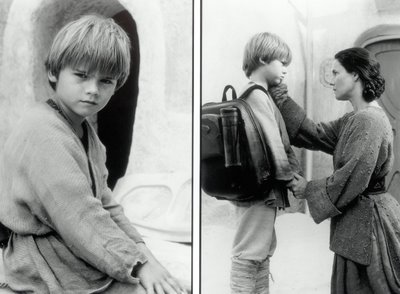
"I will become a Jedi, and I will come back and free you, Mom... I promise." -Anakin Skywalker
Social justice is a powerful theme in The Phantom Menace. From the opening scrawl, the viewer sees that the greedy capitalists in the Trade Federation are holding innocent Naboo hostage in protest against taxation. And what does the Republic do, as galactic protector? The Senate “endlessly debates.” Bureaucracy and regulations get in the way of true justice. Palpatine, the secret Sith Lord, says it best: “The Republic is not what it once was. The Senate is full of greedy, squabbling delegates who are only looking out for themselves and their home systems.  There is no interest in the common good...no civility, only politics...it’s disgusting…there is little chance the Senate will act on the invasion.”

In contrast, we have the Jedi! The guardians of peace and justice in the galaxy! Surely they can help! And indeed that’s how the Jedi are portrayed in much of the film, as well as the whole Star Wars saga. Qui-Gon Jinn and Obi-Wan Kenobi dispatch dozens of battle droids and help Padme Amidala navigate the treacherous Outer Rim so that she can make her plea to the Senate, and then go on to accompany her on a daring last-ditch effort to wrest Naboo back from the capitalists.

This is the view of the Jedi that Anakin Skywalker holds. Anakin is a slave, out of reach of the Republic. Unseen forces trap him: invisible detonators hidden within slaves’ bodies prohibit escape. But he hears of distant worlds, and has powerful dreams…Perhaps this is due to the Force in him. As his mother confesses to Qui-Gon, Anakin was the product of Virgin Birth: the Force conceived him, the Chosen One, to “bring balance to the Force.” He had more potential than the even Yoda. Why was he then born into a world of slavery? Why would the Force “waste” him in a dry and thirsty land, rather than birthing him into the center of the galaxy? He could have been born on Coruscant, have been found by the Jedi, trained, and developed…

Two theories. First, perhaps the evil Darth Sidious intentionally used his Force powers to create life, and he chose to create this vergence of the Force in a system (a) near to his home planet of Naboo and (b) with institutionalized slavery. He may have hoped that this would hopelessly corrupt the young person, making him an ideal candidate for Sith indoctrination later in life. This indeed was the case, as we see.
But alternatively, if we assume the Force, not Sidious, chose Anakin’s birthplace, then perhaps the Force wanted him to grow up a slave in order to learn to overcome challenges and to make wrongs right.

Perhaps the greatest evidence for the second view is the scene at the Skywalker dinner table. It’s so powerful:
“I was wondering something…you’re a Jedi Knight, aren’t you?” Here Anakin asks the question that’s been burning on his heart ever since he saw Qui-Gon.
Qui-Gon looks at him. “What makes you say that?”
“I saw your laser sword. Only Jedi carry that kind of a weapon.”
Now Qui-Gon puts on a poker face but grants a subtle smile. “Perhaps I killed a Jedi and took it from him.” He tests the boy.
“I don’t think so. No one can kill a Jedi Knight.” A sense of finality, as if the statement were too obvious.
But Qui-Gon’s gaze goes blank. “I wish that were so.” A pivotal moment; perhaps Qui-Gon is remembering other Jedi he’s lost. But more importantly, he may sense a foreshadowing of his approaching death at the hands of Darth Maul. Anakin has (unexpectedly) caught on to something…

But I digress; my main point in saying this is that Jedi are almost mythological to Anakin, the boy who believes in angels (“They live on the moons of Iego,” he tells Padme). They are omnipotent.

Most importantly, we see that for Anakin the Jedi are bringers of justice. In the most momentous lines of the scene, Anakin declares:
“I had a dream I was a Jedi. I came back here and freed all the slaves…have you come to free us?”
Qui-Gon starts, “No, I’m afraid not…” and pauses.
Anakin looks at him doubtfully. “I think you have…why else would you be here?”

There! That exchange! Anakin sees this mysterious Jedi as potentially the Messiah, the one to set the captives free, the one to overthrow the gang lords and slave masters, the one to break the chains of bondage! More importantly, Anakin hopes and dreams that he himself could perhaps be such a Messiah to his people.

"Are you sure about this? Trusting our fate to a boy we hardly know?" -Padme

Zoom out, fast forward. 30 C.E., in dusty, remote Nazareth, a woodworker stands up in the synagogue and unrolls the ancient scroll handed to him. “The Spirit of the Sovereign Lord is upon me, because he has anointed me to proclaim good news to the poor. He has sent me to proclaim freedom for the prisoners and recovery of sight for the blind, to set the oppressed free, to proclaim the Year of the Lord’s Favor.” He rolled up the scroll, sat down; all eyes were upon him. “Today this scripture is fulfilled in your hearing.”

Anakin and Jesus. Both are born into institutionalized oppression, whether it’s the Romans or the Hutts. Both see themselves as the fulfillment of a centuries-old prophecy. Both face opposition from reluctant families and disbelieving local neighbors. Both have early, miraculous victories: Jesus heals the sick, gives sight to the blind, and raises the dead; Anakin is the only human who can race podracers, and wins the Boonta Eve Podrace, becoming a hero to the entire slave population on Tatooine. Yet neither Jesus nor Anakin lead a popular revolution against the evil rulers.

But this is where Anakin’s case is different from that of Jesus. For although Jesus’ decision against violent revolution reflected his own values of unconditional love for all, Anakin had slightly different values. Unlike Jesus, Anakin wasn’t God; he didn’t have to be totally perfect and could have overthrown the government of Tatooine even if it took a few lives. After all, this would fulfill the prophecy and would be the right thing to do. The Force does not require exactly the same moral code that Jesus preached.

So why didn’t Anakin bring freedom to the captives, release for those in bondage, to proclaim the year of liberty? Because the Jedi co-opted him, grabbing him from his home planet while neglecting the fate of all those left behind, enslaved. Anakin is the movie’s moral compass and knows the right thing for the Jedi to do is to free the slaves—it’s a clear violation of Republic law, to which Tatooine is signatory. Yet the Jedi do things “by the book:” they grab him and take him in for their own training. Indoctrination. And even then? Masters Yoda and Mace Windu look down upon this boy who doesn’t fit their preconceptions of a proper Jedi. “I sense much fear in you.”  Anakin and his abilities are constantly put down, rather than encouraged: “The Council forbids me to train you.” “Stay in that cockpit [away from the battle]!” Poor Anakin only wants to help, but in the end, the Jedi way constrains and hampers him…

All of these elements play into Anakin’s eventual framework shift that leads him to embrace the Dark Side in Episodes II and III, as I wrote about in my previous blog. The Jedi have fallen so far that they ignore the plight of an entire planet caught in slavery. Anakin is born to deliver them from captivity, but the Jedi—the very ones who should care most—are the ones who whisk him away just as he begins his messianic path. In Episode II, when Anakin returns to Tatooine and sees that not only have slavery and violence grown worse, they’ve taken his mother’s life, he vows to never let this happen again. Thus, when in Episode III the Jedi threaten to keep him from saving Padme’s life (a future he recognizes, again, from his dreams), Anakin decides to oppose the Jedi and side with the Sith. Not out of selfishness! But because he loves her too much and can’t afford to let dusty Jedi philosophy get in the way of that. (Similarly, when Jesus told a lame man to stand up and pick up his mat, he was ordering someone to break the Sabbath. The Jewish laws had gotten in the way of doing good, and he did not hesitate to break them when that was the case. There are many more examples; you can find a few at this blog.)


Anakin is a flawed character, yet ultimately very similar to Jesus all the way from his Virgin Birth to his sacrificial death and reappearance to those he loved. I do not think George Lucas intentionally made Anakin like Jesus. I think he wrote a gorgeous, compelling narrative. However, to write a story that rings true to us, he reflexively drew upon the same themes that are present in every great story: love, justice, sacrifice, reconciliation, good vs. evil, pride vs. humility.

But these are not just ethereal ideas. I believe they entered into space and time, becoming concrete in the most beautiful, wonderful, and truest story of all human history. In this story, God loves us, and came to us. Desperate to lift us from the mud to glorious, meaningful, new lives, God made himself a lowly slave boy, caught under the heel of the most powerful Empire in human history. Jesus lived among humans, tracing a narrative arc that culminated in his ultimate sacrifice for our souls. Yet, just like Yoda, Obi-Wan, Qui-Gon, and Anakin (and Osiris, Odin, Bacchus, and other myths that approach the truth) death could not hold him down. He conquered death and offered new life to all who chose the Way of life, the Way of love. And that is what I believe. 

If any of this intrigues you, email or call me and let's talk. It's only the most important story ever told.  I'm not too surprised some of its themes made it into Star Wars too. 

Thursday, February 23, 2012

God and "The Pill"


Contraception has been in the news quite a lot lately, as the social conservative Rick Santorum tries to fight against front-runner Mitt Romney. According to Santorum,

“One of the things I will talk about, that no president has talked about before, is I think the dangers of contraception in this country. It's not okay. It's a license to do things in a sexual realm that is counter to how things are supposed to be.”

Now, Santorum is a Catholic, and Catholics traditionally hold much more conservative views on contraception than other Christians. I largely disagree with his view of contraception. However, there are some keys ways in which I think I could sympathize with his personal reluctance to use contraception.

Rick Santorum and his trademark sweater vest
But first, let me explain what we are and aren’t talking about today. We ARE talking about condoms, the Pill, and other methods that prevent sperm and egg from joining. We ARE NOT talking about abortion or abortifacients, which either kill the fertilized egg or prevent it from implanting into the uterus so that it dies, something most Christians do think is at least somewhat morally wrong. [However, to complicate matters for Christians, science shows that more than 50% of fertilized eggs fail to implant into the uterus or otherwise develop. Thus, God or Nature kills more than half of all the babies that are ever started—assuming you believe that an unimplanted, fertilized egg does indeed count as a baby. Maybe Plan B “abortion” pills that merely prevent implantation of a fertilized egg aren’t so morally bad after all! After all, that’s what happens more than 50% of the time due to natural causes….]

Also, while we ARE talking about contraception in moral terms, we ARE NOT talking about it in legal terms. Although Santorum thinks states should be allowed to ban the sale of contraception, even he doesn’t argue they actually should do so. He may personally think so, but probably realizes how controversial that would be. Thus my discussion today is purely on the moral status of contraceptives, from a Christian perspective.

Why exactly do Catholics such as Santorum think contraception’s so wrong? According to their logic, God commanded sex purely for the purpose of procreation. Thus, contraception is immoral because it means that sex would be only for fun without the possibility of having children.

This is completely wrong. While God does encourage childbearing, in the Bible there is a clear support for sex for many other reasons. Sex cements and reaffirms the covenant of marriage. Sex brings a union of male and female in a way that reflects the image of God (Genesis 1-2). Sex is to be practiced by both young and old, regardless of whether or not children are a possibility (Abraham & Sarah and Zechariah & Elizabeth are two couples who are still making love at 80+). Sexual desire is even made explicit in the Song of Songs, in which the lover describes his beloved’s breasts as perky “fawns, the twins of a gazelle.”

The one time contraception is described in the Bible, admittedly, it is described negatively: Onan “spilled his semen on the ground” in order to not impregnate his dead older brother’s wife (Genesis 38). God, out of anger, killed him. However the anger was due to his not fulfilling his duty to continue the line of the firstborn. Onan selfishly messed up the family tree. However, such guidelines are part of the Old Testament guidelines that the New Testament overrules: nowadays, if I had an older brother and he died, no church in the world would insist I impregnate his widow to continue his family line.

Thus, I am totally ok with the use of contraception in the context of marriage. It should definitely not be banned.

BUT! I do think there are some potential reasons that Christians may want to consider not using contraception, reasons that I have not yet really heard from Catholics.

First, contraception means Christians are less reliant on God in yet another area of their life. Already, technology and prosperity mean that most Americans can get along just fine without God. We do not need Him for our daily facebook, Internet, and cell phone service, let alone our daily bread. Contraception is just another area of claiming control over an area of life that God used to control: I’m going to decide when I get pregnant and when to have children. A choice to not use contraception in marriage might make a Christian depend more on God: life plans get disrupted, but that happened to the early Christians too. A life of radical discipleship requires the willingness to let go of our own plans and to willingly follow God in His.

Secondly, contraception limits family size. Having a larger family is very counter-cultural in the West; people think it’s too chaotic or costly. But in reality, cost per child goes down the more children you have: buying bulk foods makes more economic sense, hand-me-downs limit new shopping…the difference between having two children and three is really not that much. There’s a lot of joy in having a slightly bigger family, and stepping away from contraception might enable some Christian families to experience and be a witness to this in a radical and life-giving way. 

Thirdly, in the absence of contraceptives, couples can still practice the rhythm method of birth control: only having sex during the two weeks per month when the woman is not ovulating. While less effective than actual birth control, the rhythm method would have an interesting and really cool result in marriages. Couples would now have a time of rest, of Sabbath, of being apart, and then a better, more glorious joining together during the next two weeks. There’s this idea in American culture that sexual tension always has to be gotten rid of immediately, that we can’t live with it. I think that’s totally wrong, and thus part of why I’m living in that tension now. A time of tension can be very fruitful and productive. Couples would learn to appreciate each other, and sex, more.


In conclusion, where do I fall? I do think God gave us a ton of free will. That’s a separate blog, but something I believe very strongly in. I think he often gives us a large degree of complete freedom in choosing occupations, spouses, and whether to have children. Sometimes he might prefer one option over another, but other times the choice is entirely up to us. Thus I think I would affirm contraceptives for Christians who prayerfully choose that option. Perhaps they are missionaries in North Korea and cannot afford to have a kid, or perhaps they want to limit the environmental degradation to God’s creation that a large population causes. Whatever the case, if the issue is prayerfully and mutually decided upon in the context of marriage, I think they make the right choice. 

Saturday, December 10, 2011

The Battle on the Mount of Olives

In war, a battle can be won or lost based on which side holds the high ground. Thus tiny differences in geography, shaped after millennia of rain, wind, and heat, come to mean life or death. This is true today of the Mount of Olives: two embittered foes vie for control over the place on which the Messiah is said to one day appear...

When I studied abroad in Jerusalem, I would often go on runs around my campus on Mount Scopus (Har Harzofim), the tallest peak of the ridge that makes up the Mount of Olives. The most beautiful part of my run was always at one particular outlook that looked eastward, towards the arid Judaean hills and Jordan River valley. I often would take a break to stop and pray, enjoying some quiet time with God among the olive trees.
The slope on the east side of Mount Scopus. Isawiyya is off-screen on the left, and Al-Tur is near the center-right of the frame (Berg, 2011). 
The dramatic landscape makes it a popular stop for tour groups (Berg, 2011).
The panorama at this point was much different from earlier on the run, which overlooks the congested, dirty Palestinian village of Isawiyya. Isawiyya, while technically in East Jerusalem, falls under strict Israeli regulations and building codes designed to keep suffocate the Palestinian population of the city. Isawiyya is cut off on one side by the 10-foot tall concrete wall Israel constructed to impede suicide bombers. One of the two checkpoints into Isawiyya was recently closed, adding 20 minutes to any Palestinian worker's commute to Jerusalem. Palestinians cannot build new houses, or build additional floors. Thus Isawiyya, like the nearby town of Al-Tur, is rampant with overcrowding, garbage, and illegal construction (together the two towns have approximately 30,000 inhabitants). 
On the left, the modern Hebrew University of Jerusalem. On the right, in the valley, the dirty Isawiyya slum (Berg 2011).  
Isawiyya as seen from Mount Scopus on Nakba Day (Berg, 2011).
Human rights organizations both in Israel and abroad protest the Israeli government's ban on Palestinian construction, while countenancing the illegal construction of Jewish settlements on private Palestinian territory. They had argued for years for the rights of Palestinians to build on land they owned on the eastern slope of Mount Scopus. However, last week, the Jerusalem city government declared all that privately owned Palestinian land to now make up a national park.
View from Isawiyya looking west up to Mount Scopus. You can clearly make out additional land Palestinians could build on, and there is much more land out of frame off the left side of this photo (Sheikh Jarrah Solidarity, 2011).

A map of the proposed national park plan.
This section of land, while picturesque, is far from worthy of being a national park. It's only comprised of a small "wadi" (valley carved into the land from the winter rains) and a scattering of scraggly thorn bushes and wild olive trees. Many observers speculate that the real reason behind the park is to cut off any hope of expansion for Isawiyya and Al-Tur, thus dooming them to even more over-crowding in the future. In frustration, residents of Isawiyya (usually children) have been known throw rocks at nearby or police forces, burn tires, and even toss Molotov cocktails. Here you can see some smoke from a burning tire on Nakba day, the day the Palestinians protest their forced exodus in the 1948 war (filmed by Berg, 2011).

The war over this tiny slice of land on the eastern slope of the Mount of Olives is representative of Israel as a whole: tiny pieces of land are ultimately so much more than that. They can mean peace or war, life or death. This seems to be a theme for Israel: infinite value packed into just a couple of square miles. The Temple Mount. The Valley of Meggido. And the Mount of Olives.

One day, Jews and Christians believe, the Messiah will descend upon the Mount of Olives. It shall split in two, and a river will flow between the halves eastward to the Dead Sea. Tradition says dead will be raised and follow the Messiah into Jerusalem. He Messiah will usher in a new age of justice and peace, and all the evils of humans will be reversed. I hope that those who have control over Mount Scopus and the Mount of Olives will remember this, and therefore deal justly with its inhabitants. Every person's actions will be judged, and only those who have treated their neighbors with love will be able to stand. Thus, I believe the Israeli government should reverse its decision and instead allow Palestinians to build on the eastern slope of Mount Scopus. 

Friday, December 9, 2011

7 Provocative Things I Learned From NT Wright’s Book "Surprised By Hope"


A couple of months ago, while attending a debate tournament at Swarthmore College, I overheard an interesting debate topic: that Jesus’ life would make better literature if he had not been resurrected, if he had simply been crucified, buried, and rotted. I then heard some of the arguments for why this might be true. Jesus’ followers would better be able to take up the mantle of their martyred leader. He would fulfill the classic storyline of the sacrificial hero: dying for the sake of the ‘cause’. In this view, Jesus’ resurrection seems a tacked-on, Disney ending that makes an epic story into an artificial-sounding, feel-good tale with less of a lasting impact.

At first glance, this sounds like a persuasive argument. But I really wish I had been the one to debate against this topic, because I firmly believe that Jesus’ resurrection is incredibly important—more important, in fact, than his death on the cross (1 Corinthians 15:14: ‘And if Christ has not been raised, our preaching is useless and so is your faith’). That is the first provocative thing that I learned from reading NT Wright’s book, Surprised By Hope. I’ll quickly go through a few others.

1. The Resurrection, not the Crucifixion, should be the center of Christianity.
            As NT Wright argues “Sin is the root cause of death; so if death has not been defeated, then that means sin has still not been dealt with” (247). Thus, modern Christianity’s focus on Jesus’ death on the cross is really missing the point. His death AND resurrection were what enabled humans to be forgiven and freed from the chains of sin and death. Moreover, resurrection is a focus on the positive, victorious nature of Jesus rather than on the suffering at Golgotha. NT Wright also argues that Easter is not a big enough deal in the Church’s liturgical calendar: it should be a PARTY, complete with feasts and drinking and dancing. In the status quo, we have forty days of intense sorrow for Lent and then a single half-hearted Easter service to end it. It should be the other way around, if anything. Jesus’ resurrection is where we draw our hope; it was the totally unexpected, surprising revelation of his glory. Jews believed that everyone would be resurrected at the end of time, but Jesus foreshadowed that event with his resurrection, shattering even the disciples’ wildest hopes.
If we don’t center our theology on Jesus’ resurrection, death still has the victory: the best humans can hope for is to die quickly and join God in a spiritual heaven, leaving our bodies here. Which gets me to the second provocative point.

2. When a Christian dies, he or she will NOT be in a spiritual heaven forever.
            Wow. Incredibly provocative. Nearly everyone I hear present the Gospel message talks about how if one accepts Jesus into one’s heart, one will spend eternity in heaven with God. And that is 100% false.
            Why? Because as predicted in Zechariah, Isaiah, Revelation, and throughout the whole Bible, God’s people will one day live with him in a remade, renewed, recreated, physical, redeemed, perfect Earth. Heaven is just a temporary resting place where we wait until the resurrection. Then, at the last day (or the first day, depending on your point of view), we will be resurrected into new physical bodies and God will descend down to Earth to live with his people forever. The dead are all to be raised and judged accordingly, some to eternal life and some to death. God, for his part, experiences a permanent change of address (Revelation 21:3 “Look! God’s dwelling place is now among the people, and he will dwell with them. They will be his people, and God himself will be with them and be their God”). The story of the New Testament is fundamentally not about people going to God. It’s about God coming to people: this was symbolized with Jesus, and ultimately to be fulfilled at the end of time. And when God comes, he will enter—as in Eden and Bethlehem—into the physical world. That will be final reality, not ‘heaven’. There will be a new heaven and a new, perfect earth, but the Bible clearly shows that our final, eternal home will be on the new, physical earth with God, forever.

3. Well, allow me to amend that previous statement: heaven and earth will, on the last day, meet and join together as one unified location.
            I suppose that’s the more accurate way to say it. Throughout the book, NT Wright critiques the Platonic idea of separating soul and body, elevating the soul and denigrating the body. In the Platonic view, Jesus’ ascension into heaven is a case where “Oh, now he’s in all of us, how nice” a la the debate case I heard at Swarthmore. A more robust view, however, says that the Bible means what it says: Jesus, in his body, actually disappeared into heaven, and there’s a physical Jesus in heaven right now waiting for the moment when he can make his royal “presence” known (parousia, the word connected with inaccurate Rapture theology). While Jesus’ Spirit is in the Church, the Church is not Jesus. Jesus is still missing, there’s a curious absence which creation “groans” to fill (Romans 8).
            Right now, the best we can do is to let God use us to bring little slices of the kingdom of heaven to earth, but realize that we can never fully establish heaven on earth until Jesus does at the end of time. But that does mean we can anticipate that event the same way Jesus’ resurrection anticipates our own. Thus Christians should be deeply involved in social justice and in restoring our world: in so doing, we are looking forward and giving witness to the last day when heaven and earth finally meet like a kiss.

4. The Rapture is not a real thing and will not happen the way Christian culture assumes it will
            Also a very provocative claim. First, let me point out that absolutely nobody had the idea of Christians souls being sucked from their bodies in a Rapture until around 1850, when an American preacher believed he had revelation from God and figured it out. According to him, God would take all his people from the Earth and then essentially nuke the earth with various judgments. But the way Paul talks about the parousia or “coming/presence” of Christ does not imply that at all. Rather, Jesus’ re-appearing occurs when he comes back to Earth to establish his eternal kingdom and triumph over evil once and for all. At the trumpet call, Christians will “leap up” to meet God in the air, but only so we can escort him down onto Earth. In ancient protocol, when the king comes, you go out to meet him so you can usher him into the city. A tiny bit like going outside to help your mom bring in the groceries. There’s absolutely nothing about having our souls sucked out to be with Jesus in the parousia/Rapture. The only time our souls are separated from our bodies is when we are dead, and that is only temporary.

5. Modern Christian Liturgy is Missing the Point 
            I mentioned earlier that NT Wright wants an Easter-centric liturgical calendar, in order to avoid modernity Christianity’s extreme focus on Christmas and Lent. The resurrection ought be the center of our faith and the foundation for our future hope. Enough said.
            NT Wright critiques another popular practice, cremation. While admitting that obviously God can resurrect any person’s body, regardless of what physical remains are still there, burying a full body is a better symbol: just as Jesus was buried and resurrected whole, we will be buried and resurrected whole. Cremation is more akin to the Platonic belief that the spirit, and not the body, is what matters. Too much of modern Christianity is more like Plato than Christ, NT Wright argues. We hate the body and long to be freed from it “in heaven”. But Jesus affirmed both the body and the soul, and we should do the same. Yes, both are currently corrupted, but both shall be one day wholly restored. The physical and spiritual healings that we may experience here on Earth are a foreshadowing of that glorious day.

6. In the same way that Jesus’ resurrection from death anticipates our own final resurrection; Jerusalem’s destruction and burning by the Romans in 70 C.E. anticipates the final judgment for those who reject God’s kingdom      
            For this point I’m going to quote from NT Wright regarding Gehenna, the smoldering pile of burning rubbish in a valley near Jerusalem that represents hell: “Jesus’ message to his contemporaries was stark and political. Unless they turned back from their hopeless and rebellious dreams of establishing God’s kingdom in their own terms, not least through armed revolt against Rome, then the Roman juggernaut would do what large greedy, and ruthless empires have always done to smaller countries… Rome would turn Jerusalem into a hideous, stinking extension of its own smoldering rubbish heap. When Jesus said, ‘Unless you repent, you will all likewise perish,’ that is the primary meaning he had in mind.”
            Thus the destruction of Jerusalem, like the resurrection of Jesus, prefigures the future—a fact often overlooked by Christians. If people refuse to repent and instead insist on pursuing earthly kingdoms rather than the kingdom of heaven, they will find themselves destroyed by fire. “Those who live by the sword will die by the sword.”
            Note that NT Wright does believe in the final reality of hell. In the age of Rob Bell, it’s helpful to have a solid, biblical, yet compassionate analysis of the topic of hell. I’m not covering it here for sake of time, but it’s definitely worth checking out. 

7. Those who deny miracles still occur in the modern world (using 1st Corinthians 13 as their scriptural basis) better change their position.
            When one reads 1 Corinthians through the lens of the resurrection, things make a lot more sense. Particularly the section in ch. 13 that declares “prophecy, tongues, miracles etc. will be done away when the completion arrives.” Some modern Christians argue that we ought not see prophecy or miraculous healings because the completion has already come. Thus they denounce any church that has these things. But the completion to come is the resurrection. When the resurrection comes, tongues and healings will cease. This is shown in the Old Testament too: Zechariah 13, which describes the renewed, post-resurrection Earth, explains that no one will prophesy anymore.
            In fact, it’s precisely because the completion has not come that healings, tongues, and prophecies still exist (or should—if you don’t see any near you, you might want to consider finding a place where they do). There is still sin and pain, and thus we still need the Holy Spirit’s supernatural intervention. And with that intervention, we catch a glimpse, a foreshadowing, of the new heaven and the new earth, where there will be no more pain, no more death, and every tear will be wiped away. And when we have that, then there will be no need for tongues and prophecy. Because in that day, the perfection will come, and the knowledge of God will cover the earth as the waters cover the sea. 

Saturday, November 19, 2011

#OWS: Not Tahrir, Not by a Long Shot

This is just a quick blog to get my thoughts out until I have time later (which is doubtful), so message/email/call me if you want to hear more about my thoughts on this issue.


Last night, I was walking around downtown Lancaster with my friend Mike and we decided to stop by the local “Occupy Wall Street” gathering, Occupy Lancaster. When we arrived, we were handed a couple of pamphlets urging the “99%” to rise up and protest the oppression of the “1%.” We then sat in on a meeting where the shivering, sickly protesters discussed recent crackdowns in Harrisburg and New York against other #OWS movements.

The occupiers seemed genuinely concerned about their rights and freedom. One man explained that in Harrisburg, the police ripped up a tent “with a knife! This big!” gesturing his hands about five inches apart, “And there were still people inside!” (Though there was no statement that any of those people were actually harmed in this action). Those gathered around the circle expressed their shock and horror, lifting their hands and wiggling fingers—the #OWS form of silently agreeing with a speaker.

But meanwhile, I had to stop myself from laughing. I’ve spent the last three months reading about female genital cutting, looking at pictures of decaying bodies, and watching videos of people getting run over by armored vehicles. The occupiers’ claims of injustice do not reach anywhere near what others worldwide have suffered.

While #OWS protesters have some serious arguments about the nature of our capitalist society, I’m dubious about how much injustice they really are suffering. Protest movements can only gain traction when there is a real sense of suffering or the government is tricked into overreacting—which explains why Egypt’s government has been overthrown, but America’s has not.

What do you think? Does economic and political inequity constitute a human rights violation, or is this just part of modern society? Are these protests in the same vein as the Arab Spring, or is this just the whining of educated white kids? Can the protesters really complain about police brutality, or are they overreacting?

Tuesday, October 11, 2011

Water from the Rock


Lately I’ve been doing a lot of reading about Jewish festivals, and the more I learn the more incredible the connections to Jesus seem. Please forgive the somewhat rushed nature of this blog, but to take the time necessary to fully explicate all the amazing connections would take time that I just don’t have right now.

This week, followers of Judaism celebrate the seven-day festival of Sukkot. In Sukkot, they remember God’s provision by symbolically setting up flimsy tents outside in the elements. In this they remember that God liberated them from slavery and kept them safe through the desert, despite having no material possessions. In contrast to “Gog” and “Magog”, the nations in Ezekiel 38 whose names refer in Hebrew to ‘roofs’, the Jews are a nation without roofs. The man of Gog believes in self-security, in providing for himself, in making sure he has enough money and resources and friends to be safe. The man of God, on the other hand, trusts in God, that God will provide.

There is another thing about Sukkot that I find incredibly interesting. In Simchat Beit HaShoeivah, which was practiced each of the seven nights of Sukkot, the priests would pour out water onto the altar. But the name for this does not translate to the ‘dumping of water’, but as the “joyful place for the drawing of water”. As if the water were coming from the altar, not the other way around…How can this be?
Because throughout all the prophecies in the Jewish Scriptures, there are particular ones that foretell of a day when water will flow out from Jerusalem and provide water to the whole arid landscape around it. Water that is so refreshing it turns the Dead Sea into a living sea that can support fish. Water that flows “from the Temple”. Water from a rock? Crazy symbolic...but I’m getting ahead of myself.

Thus the Ceremony at the place of the Drawing of the Water was a foreshadowing of these prophecies. Correspondingly, there was great joy attached to it. In fact, Jewish scriptures say: "He who has not seen the Simchat Beit Hashoeva has never in his life seen joy!" The greatest joy in the world, which only increases in happiness each night, culminating on the final day of the Feast.

Cut to the book of John, chapter 7: “On the last and greatest day of the festival (Sukkot!), Jesus stood and said in a loud voice, “Let anyone who is thirsty come to me and drink. 38 Whoever believes in me, as Scripture has said, rivers of living water will flow from within them.” This is the day of greatest joy, of greatest happiness, the foreshadowing of the rejuvenation of the world. And Jesus makes this radical claim that the time of the water flowing from the altar was NOW. In the midst of the joyful procession, Jesus proclaims that the source of water was in fact in their midst!

Skip ahead to John Chapter 19: Jesus is dead on the cross. Then, “one of the soldiers pierced Jesus’ side with a spear, bringing a sudden flow of blood and water. The man who saw it has given testimony, and his testimony is true. He knows that he tells the truth, and he testifies so that you also may believe.”
It seems this tiny detail, a flow of blood and water from Jesus side, is so important that John has to swear immediately afterwards that it is true. Why? Because blood is necessary for the forgiveness of sins. And water is necessary to fulfill the prophecies about reviving the world. Jesus uniquely fulfills both aspects at once.

Last week was Yom Kippur, which occurs for forgiveness. This week is Sukkot, for a flood of water to renew the lands. And Jesus combines the two. Blood and water, poured out onto the earth for its full, complete redemption, a redemption that cleanses us and gives life to our world.

  
[If you’re interested in learning more, check out my earlier blog, Streams in the Desert. Also check out the Wikipedia articles about Sukkot and Simchat Beit HaShoeviah, as well as Zechariah 13-14, Revelation 21-22, Ezekiel 37, and Joel 3:18.]

Face to Face

"For now we see in a mirror, dimly; then we shall see face to face. Now I know in part; then I shall know fully, even as I am fully known..." (1 Corinthians 13:12).

Today I met a Sudanese refugee and her six year old son. Smiling, she told me her story in broken English. She came to Lancaster about two years ago, and now plans to apply for citizenship in three years. She was from a city about four hours south of Khartoum. "Is that now in South Sudan?" I asked her. No no, she told me, even four hours south of Khartoum is still far from South Sudan. I had kind of guessed that, since she spoke Arabic to her son (a characteristic of the more Arabized north versus the African dialects in the south). With the language barrier and having just met her, I didn't get to ask the full details of her escape from Sudan. But somehow, finally meeting a real-life refugee made things more real to me. Refugees are actual, regular people: normal humans who laugh, cry, eat chips with homemade salsa, and forget the English word for "south". 

The quote at the top of this post is from a chapter in the Bible I read this morning. Little did I know how much it would frame my meeting with this refugee. After weeks of sitting and learning in class (Human Rights, Human Wrongs), us students do "know in part". This is like seeing something in a dirty mirror, dimly...but when we see the face of human rights face to face, we shall know fully. Something will leap out past our intellect, and lodge deep into our hearts. And that is how it should be. 

Thursday, October 6, 2011

The Ultimate Day of Atonement


In some recent research to learn about Yom Kippur, I came across an absolutely astounding writing from the Jewish tradition that if you blink you might miss it (It might take a little bit for me to get to my main point so make sure you read to the end). Yoma is a Jewish rabbinical text from the Babylonian Talmud written around 200 AD/CE.. Read what it says in its section on Yom Kippur:

“Our Rabbis taught: During the last forty years before the destruction of the Temple the lot [‘For the Lord’] did not come up in the right hand; nor did the crimson-coloured strap become white; nor did the westernmost light shine; and the doors of the Hekal would open by themselves, until R. Johanan b. Zakkai rebuked them, saying: ‘Hekal, Hekal, why wilt thou be the alarmer thyself? I know about thee that thou wilt be destroyed, for Zechariah ben Ido has already prophesied concerning thee: Open thy doors, O Lebanon, that the fire may devour thy cedars’ (Yoma 39b).”


OK so let’s talk about what’s happening here, in order.

So first, author states that the “lot did not come up in the right hand”; this refers to the lottery selecting which of two goats would be sacrificed ‘for the Lord’ and which one would be driven off into the wilderness ‘for Azazel’. Essentially, having the bad lot ‘for Azazel’ come up first each time for forty years straight was seen as a very bad omen by the author of Yoma (and statistically nearly impossible). It gets worse though.

           The crimson strap becoming white refers to the rope that would be tied to the scapegoat. This was the goat chosen ‘for Azazel’ and thrown off the cliff of Mount Azazel into the wilderness to take away the sins of the people. Many times, Yoma states before the passage I quoted, this scarlet cord would become white as snow once the goat was thrown off, signifying the forgiveness of sins for the people (Isaiah 1:18- “Though your sins are like scarlet, they shall be as white as snow; though they are red as crimson, they shall be like wool.”). But in Yoma 39b, we see that for the forty years prior to the destruction of the Temple, the scarlet cord never turned white; driving the scapegoat off into the wilderness apparently did not accomplish the forgiveness of sins.

            The “westernmost light” also stopped shining. This refers to the lamp that supernaturally, continuously burned to signify God’s presence and blessing. Now, for some reason the supernatural ceased to burn of its own accord.

            Finally, the passage states the doors of the Hekal would open on their own. The Jewish H]historian Josephus from the first century tells something similar: "At the same festival (Passover)... the Eastern gate of the inner court of the Temple, which was of brass, and vastly heavy, and had been with difficulty shut by twenty men, and rested upon a base armered with iron, and had bolts fastened very deep into the firm floor, which was there made of one entire stone, was seen to be opened of it's own accord about the sixth our of the night" (The Wars of the Jews, 6.5.3). Thus what we see in both these passages is that the doors to the Temple would open on their own for the forty years prior to the destruction of the Temple.


Why were all these things occurring at the same time? What can possibly explain all these coincidences as reported by the Jewish Talmud? Well, the destruction of the Temple occurred in 70 AD/CE. Forty years prior to that, 30 AD/CE, happens to be exactly when historians believe the rabbi Yeshua (Jesus) was crucified by the Romans.

So in conclusion, after Yeshua was crucified, the lot started coming up in the wrong hand. The scapegoat no longer signified the forgiveness of sins. God’s presence was no longer symbolized by the ever-shining light in the Temple. And the doors blocking access to the Temple would swing open of their own accord, as if now God was henceforth permanently open to all.

Maybe after 30 AD Jesus’ death forever replaced animal sacrifice as the means to forgiveness. Maybe it also signified that’s God’s presence no longer resided in just a building. Maybe the doors to the Temple would swing open to show that God had burst out of his enclosure; a building could no longer contain his glory. Maybe He was now unleashed into the world.

Maybe the Day of Atonement was accomplished once and for all, one dark and glorious day in 30 AD. At least, that’s what Yoma 39b seems say. I’ll let you make your own opinion.


(http://www.yashanet.com/library/temple/yoma39.htm)
(http://en.wikipedia.org/wiki/Yom_Kippur)

Friday, September 9, 2011

Sixty-Three Years and Counting: Palestinian Refugees

This month, Palestinian diplomats hope to submit a bid to the UN Security Council that would have their territories formally recognized as a Palestinian state. The US promises a veto, but the Palestinians hope that a favorable vote in the General Assembly could still increase the diplomatic pressure on Israel.

Students of refugee law will find a highly complex and controversial case in this situation.  Due to a strange definition by the U.N. Relief and Works Agency (UNRWA) tasked to the situation, not only the Palestinians who fled in the 1948 war are classified as refugees, but also their descendents. This means that the half a million refugees from 1948 have ballooned to a current total of nearly five million. Israel, fearful of losing its Jewish demography through a wave of immigrants, refuses to contemplate offering any “Right of Return” to these refugees. Meanwhile, more and more Palestinians are born stateless, having neither Israeli citizenship nor citizenship in the nonexistent Palestinian state. Instead, they merely get refugee status cards from UNRWA (and none are automatically eligible for asylum in the US because they do not have a “well-founded fear of persecution”; a life of poverty does not qualify).

These refugees do not live in the worst of conditions: the refugee slums I saw in the West Bank city of Nablus did have concrete buildings and narrow roads. These are not the tattered tents one would see in Darfur, for example. But existing without rights, having only a hostile Israeli government and a nascent Palestinian one, these people see little hope of ever gaining justice. Accordingly, many turn to violence. I saw many posters idolizing armed teenage boys, “martyrs” against the occupation. (“Idiots,” commented one Palestinian, "This kid was throwing rocks at a tank.”)
Palestinian Refugee Camp in Nablus, West Bank. Note the banner honoring "martyrs" who had died fighting the Israeli occupation. 
What is the answer to the Palestinian refugee problem? I believe that it is impossible to return these refugees to their family hometowns in Israel. It’s been over sixty years and the landscape has been completely changed. Moreover, I know Israel will not grant citizenship status to Palestinians for fear that they would become an electoral majority and take over the “Jewish” state. Thus, I think the only fair thing to do would be to permit the Palestinians to form a state, placing the responsibilities of rectifying the refugees’ social justice claims in the hands of their own people.

Thus, I believe the US should not veto the Palestinian’s bid for statehood. Instead, it should vote in favor of it and immediately begin working with Israel to craft safe, secure borders between the two states.