Friday, September 21, 2012

Moral Confusion and the Role of the "Chosen One" in the Star Wars: Episode III Universe


[Originally written October 17, 2010. For a follow-up blog, see "Anakin Skywalker: Tatooine's Messiah"]. 


Star Wars Episode III: The Revenge of the Sith upends the moral compass of the traditional Star Wars universe as the millennia-old tension between Jedi and Sith comes to a head. From the very opening scrawl, a moral impossibility is thrust upon the audience. “War! The Republic is crumbling under attacks by the ruthless Sith Lord, Count Dooku. There are heroes on both sides. Evil is everywhere.” This seems impossible. How can there be heroes on the vile side of the Separatists’ droid armies AND on the side of the Republic’s clone troopers and Jedi? How can evil and good exist on both sides?

     This highlights the moral proposition that Lucas gives us in Revenge of the Sith: that the same moral “flaws” that are thought to lie solely on the Dark Side exist just as much on the Light Side. Lucas’ criticisms here show exactly why Anakin, the Chosen One, was needed to bring balance to the Force—a role that he does not fully accomplish until Episode VI.

     The institution of the Jedi Order, like any institutionalized religion, is not immune to the vices and weaknesses of beings. While called ‘defenders of the peace’ by Mace Windu in Episode II, by Episode III their role has grown into one of exerting force through the military. Jedi are now ranked as “Generals” and lead battalions of clone troopers on a myriad of worlds across the entire galaxy. Spread thin, they are far from the community of each other and have their consciences worn down as they watch their campaigns kill millions. In a strange twist, many Jedi grow closer to their clone troopers than they do to each other: long-term fighting has shifted their mindset to be like clones that have been specifically bred to fight and kill.

     Moreover, the special insight the Jedi have from the Force has been disappearing. Even in Episode II, the Jedi know that their ability to sense the future has diminished. By now, it is completely gone, so far gone that they cannot discover the Sith Lord right beneath their noses. Thus the Jedi have turned into super-soldiers with special abilities, but they have no ability to be moral prophets, blinded by the growing power of the Dark Side (Or are they blinded by their own faults? Does Jedi militarism detract from their focus and thus keep them from being able to grasp what is truly happening in the galaxy?)

     The Separatists, while certainly rebels, only desire more freedom from the over-centralized, corrupt Senate on Coruscant. In particular, they want more freedom of trade and commerce—hence the support of the Commerce Guild, the Banking Clan, the Trade Federation, and Techno Union. As the war drags on and claims billions of lives, some start to wonder if the war is worth fighting. This is another element of Lucas’ critique: the Jedi are blindly serving the Republic, when they cannot be sure they are actually fighting for the best side. Padme wonders aloud, “Have we become the evil we sought to destroy?” Yet this is a question the Jedi never stop to ask. Like America in the Vietnam War, they continue to fight without really knowing why. Later on, the remnants of the Separatists form the nascent Rebel Alliance, and the ‘enemy’ becomes the good guy.

     Additionally, the Jedi are over-dogmatic. Anakin Skywalker is the classic foil to the Jedi. He is special, the “Chosen One” with greater Force potential than any Jedi, and yet is nearly refused from the Jedi Temple because Yoda deems him too old and too afraid. Anakin is the Jedi who breaks the rules, who knew his family, who gets married. Anakin, despite his mastery of the Jedi way, finds himself an outcast, a reject, from the inner circle of the Jedi. Partly that is his own fault because of the secrets he hides even from Obi-Wan (Padme, the Tusken Raiders), but the Jedi Order is at fault as well. Mace Windu especially harbors deep, obvious disdain and mistrust of Anakin. When he is appointed to the Jedi Council, Mace pointedly shuts him down and makes sure Anakin knows he is only accepted provisionally, without the ranking of Jedi Master. This is especially hurtful to Anakin in particular because he needed the Master ranking to access secret Jedi Holocrons in hopes of finding a way to save Padme.

     Jedi dogmatism alienates Anakin and provides leverage for Palpatine. “Did you ever hear the tragedy of Darth Plagueis the Wise?” he asks Anakin. “I thought not. It’s not a story the Jedi would tell you.” Palpatine has done two things here: painted the Jedi as withholding of vital information, and shown himself to be the Provider of this information to Anakin. Jedi dogmatism forbids the teaching of Sith legends and practices, not realizing that they would soon pay for their ignorance. After all, prior to Darth Maul’s appearance in Episode I, the Jedi Council had claimed that the Sith had been extinct for millennia— a serious miscalculation.

     Another realm of Jedi dogmatism lies in the area of the passions. Episode II highlights this tension perfectly: Anakin struggles to explain to Padme how the Jedi can be forbidden to love, and yet also are called to take care of the galaxy. Can one care for another being without loving them in some way? Perhaps, but the deeper problem is what to do with passions when inevitably arise. Qui-Gon Jinn and Obi-Wan had had their own flames when they were younger, but they had been with fellow Jedi and only after more extensive training. Anakin, on the other hand, had been taken in at ten years old, after many of his passions had been allowed to grow (“I sense much fear in you” Yoda says in Episode I).

     Anakin’s forbidden marriage to Padme flies in the face of Jedi laws against attachment. These laws had served the Jedi well for centuries, as attachment did not mix with the semi-nomadic, risky, and servant role the Jedi had in the galaxy. Attachment could breed greed, jealousy, and favoritism. The danger was that a Jedi would threaten the greater good in order to save the one they cared about. As Yoda tells Anakin, “You must learn to let go of everything you fear to lose.” But can one blame Anakin that he has emotions, when these come so naturally to humans?

     Thus when Anakin states that the Sith rely on their passion for their strength, the viewer wonders if perhaps that is what Anakin is doing as well. In the fight against Dooku aboard Grievous’ ship, it is only when the Count goads Anakin on that Anakin truly starts fighting fiercely. It seems that Anakin does use his emotions to defeat Dooku: his fear for the wounded Obi-Wan’s life, his anger against the evil Dooku, and his pride (“My abilities have doubled since the last time we met”). As they battled right in front of the captive Supreme Chancellor, Palpatine could hardly have missed what was happening to Anakin… and had been happening: “Remember what you told me about your mother and the Sand People?” he reminds Anakin of his massacre.

Two blue lightsabers. Who's the bad guy? Who's the good guy? Maybe it's not so simple...

     Another contradiction on the side of the Jedi is that while they emphasize cool, dispassionate thinking, they also rely heavily on “feelings”. In the beginning of Episode III, both Obi-Wan and Yoda separately advise Anakin to “search [his] feelings”. This is essentially a euphemism for “listen to the Force”, and we’ve heard that before. But Palpatine gives Anakin the same advice, to search his feelings about the true intentions of the Jedi. And it works—Anakin dwells upon his growing doubts about the Jedi, and those doubts are reconfirmed upon reflection. This is not manipulation by Palpatine. The Force truly is telling Anakin about the flaws in the Jedi. After all, they asked him to spy on Palpatine, and Mace Windu refuses to trust in Anakin. Lucas therefore uses the Jedi’s own mantra against them. Thus when Palpatine states that the Jedi are planning to take over the Republic, Anakin senses enough truth in that statement to not reject it on face.

     Lucas’ critique of the Jedi dwells especially on their veiled moral relativism. Obi-Wan screams at the end of Episode III, “Anakin, the Sith are evil!” Anakin replies, “Well from my point of view the Jedi are evil!” “Then you truly are lost,” Obi-Wan states with finality. Yet this is highly ironic, for only twenty minutes earlier Obi-Wan had told Anakin: “Only a Sith deals in absolutes.” Thus Obi-Wan’s own position is to be relativist when it suits him and absolutist when it suits him. This is true elsewhere in the movie as well. Jedi dogmatism says never to execute prisoners, and doing so to Dooku does give Anakin a guilty conscience. Yet Mace Windu is perfectly willing to execute Palpatine. The moral relativism of the Jedi is deadly to their case, because it is only in being morally superior that they can claim any kind of authority. Once Anakin sees that they operate according to their own interests, like any cause, he feels much less obligated to side with them.

     The fight between Mace Windu and Palpatine is the tipping point of the whole movie. Anakin, knowing Mace is morally wrong to want to execute the unarmed Palpatine, tries to dissuade him. He is also conflicted with many emotions: He is in a forbidden romance with Padme and has promised to save her. The Jedi show disdain for the Chancellor and have asked that Anakin betray him. The Jedi have passed over him, the Chosen One, to lead the mission against Grievous, even though he is a more capable Jedi than Obi-Wan at this point.

    Palpatine, on the other hand, offers him respect, influence, freedom to feel emotions, and new powers to save anyone he loves from dying. Anakin probably did not intend to kill Mace Windu, but he did choose to stop him. This betrayal could not be undone, and now Anakin knows he has lost all his friends and allies. Except, perhaps, for Padme. And thus with his new identity (Darth Vader), he was willing to do anything, including invade the Jedi Temple, to save her.

     Anakin did not turn to the Dark Side because he was evil. He reveals his true intentions when he tells Padme that they could overthrow Emperor Palpatine, rule the galaxy and make things the way they should be. He just wanted the freedom to love Padme and the ability to right all the wrongs he saw. The Jedi had shown themselves to be selfish and rigid, while the path of the Sith allowed him to keep his power and emotions. Anakin turned to Palpatine because he faced rejection everywhere else.

     And in the end, Palpatine was the only thing keeping him alive. After his injuries in the fight against Obi-Wan, Darth Vader was bound by Palpatine’s power to manipulate midiclorians to keep him from dying (just like Darth Plagueis could do). Thus in Episode VI when Vader throws Palpatine into the Second Death Star’s reactor shaft, he knows he is dying not because of injuries (which only involved a severed artificial hand and some electrical shocks), but rather because he had just killed the source of his life. In a final act of defiance, Anakin takes off his helmet to look at Luke in his own power, no longer dependent on the Emperor.

      So was Anakin the Chosen One? Did he bring balance to the Force? I believe that despite his fall to the Dark Side, Anakin did bring balance. I have argued that the Jedi were corrupt and misguided, listening only to their narrow view of the Force instead of what the Force actually demanded of them. The Sith, in turn, were too selfish, using the Force solely for personal power. Anakin provides a bridge between this gap. He uses the Force and obeys its moral code, but also allows himself to feel emotions and to have attachments to people important to him. While he is forced to choose the Dark Side for a while, there is still good in him. And it is not the moral code or regulations of the Jedi that bring him back to the Light. As we see in Episode VI, it is love for his son that finally causes Vader to turn against Palpatine, freeing him at last. Like God towards us humans, it is Love that redeems.

     The New Jedi Order, which Luke starts after the events of Episode VI, has fixed the problems of the Old. Jedi are now allowed to love, marry, and have children. They are accepted into training despite being “too old”, and there is a greater knowledge of the dangers of the Dark Side. Anakin truly did bring balance to the Force at last, in a role that radically changed the Jedi Order forever.

The Living Water vs. the Lukewarm: A Letter to Myself

[Letter to myself from March 6th, 2010. Pretty cool to see how I've grown since then.]


Dear Andrew,


I am pleased to have seen how you have grown recently. It is as if you are starting to finally run (or attempt to run) in the race for the prize. 
But I want to write this letter to beg you, cajole you, and frighten you to go deeper in faith. And that has to go so much deeper than just your mind.

You have a solid, discerning mind. That has helped you in your recent times of change—you have been able to understand that several of your deeply held beliefs are in fact inconsistent with the teachings of the Person you claim as your God. You have sought to reconcile the contradictions, and have not hesitated to throw out any pretension that sets itself against the Messiah.
For example, you have discarded the “power-over-others” model of power and domination that the world relies on to affect change (but that your slaughtered God refused). You have discovered an empathy for the oppressed that had formerly been covered up by a “laissez-faire” capitalistic mindset. You have learned the value of community. 
You have not ignored God’s correction in these areas of your intellect, and for that I am glad. 


But I have some things to say as God grows you.

First, you must remember that nothing you have been given, no change in yourself, is the result of you. It is God who has changed you. God has placed you with people who have changed you—some in ways you may never even imagine. Never ever forget that you would not be where you are today if it were not for their obedience to God in lovingly speaking the truth to you.
In addition, there have been omens directly from God, “Black Swan Events” that are impossible, that shouldn’t have happened, but that speak to you in an unimaginable way. Sometimes they’ve been as small as a significant phrase, other times as amazing as a prophecy or vision. If you have ears to hear, then hear. If you can remember, then remember. Like Mary, treasure these things in your heart.
So never forget that it is God that molds your heart and mind, not yourself. Never ever let a hint of pride enter in. “Someone who is conscious that he is capable of nothing has every day and every moment the precious opportunity to experience that God lives.”


A second thought I have for you is something that you have been coming across a lot. And that is to refuse the lukewarm objectivity of the formal Christian religion. Instead, choose, surrender, and bind yourself in the passionate, messy, subjectivity of a relationship with God.

Andrew, too often your faith is intellectual. Kierkegaard warns against this in practically every one of his writings. He says that to possess Christianity as a worldview is to have it precisely backwards. Faith is not about “understanding and articulating what we believe”. Faith is about an existence—to live completely as Christ. 
My twin brother in Christ, it would be far worse if you have grown intellectually but don’t live it. As Kierkegaard warns: “Most systematizers stand in the same relation to their systems as the man who builds a great castle and lives in an adjoining shack; they do not live in their great systematic structure.” Or as Paul writes, “If I have all knowledge and can fathom all mysteries…but have not love, I am nothing.” 

So Andrew, you need to make a choice. Actually, many, many choices. You need to make the decision each and every moment to be like Jesus. Many people admire Jesus; few are willing to follow him. Each decision to follow him shatters through time and reaches into eternity—there is no moment but now; there is no “later” to follow God. The time of redemption is now—don’t put it off! “Venture to give all your possessions to the poor and you will certainly experience the truth of Christ’s teaching. Venture once to make yourself completely vulnerable for the sake of the truth, and you will certainly experience the truth of Christ’s word.” 

You need to make sure that truth exists for you. It is only true for you insofar as it leads you to action. It must permeate all your being and you must accept all of its consequences. Anything less is to be lukewarm. And to be lukewarm is to be spit out in utter disgust by the God of the Universe. Hear that Andrew? You would be better off as a wicked pagan than as a half-hearted Christian. Anything less than complete and total surrender to Jesus is betrayal. If you believe in love but do not love, you are nothing.

This is not easy, and I think especially for you. In the Enlightened West, it is countercultural to think of truth as needing to be subjective. We in the West are “rational”; we have highly developed theologies, philosophies, and worldviews. They are logically impeccable. They are objectively true and can be proven through proofs. But all these proofs do is turn Christ into a system of logic that we can choose whether or not to believe in. 
But Christ isn’t a system, and he isn’t a part of this system. He’s a person and you have to choose him. I ask you Andrew, choose to be in a relationship with him more intimate than family or a lover. A relationship that actually affects what you do! In the West, we believe in our ideologies but we don’t act on them. Such a belief, such a faith, is dead! Reject this mindset and live like those in the East, who have this going for them—at least they practice what they believe (such as we see with family piety and honor in Asia). 


And as you go forward, Andrew, you must also have faith. Faith is so scary, and I know that. Abraham had faith that God was telling him to kill his son. To thrust a knife into the heart of his son. Isn’t that crazy? But Abraham had faith that even if he killed Isaac, that God could resurrect him. Abraham’s trust was so deep, so passionate.
Or take Elijah. He was a man “just like us.” But “he prayed earnestly that it would not rain, and it did not rain on the land for three and a half years” (James 5:17). How awesome! He trusted God, but not with a trust born from logic, evidence, and arguments. He trusted him in faith, blind, crazy, audacious faith.
And you’re going to need faith. Really badly. Because you’re going to screw up, and you’re going to need to have faith that God still loves you and that you are forgiven in Jesus’ Name, Blood, and Power. Remember that nothing can separate you from the love of God. 
And beyond that, if you are taking risks for God, your life won’t have a safety net. You will be forced to depend on God. And that takes faith; especially in a rich, Western society that places security and safety above all else. Instead, embrace danger, trusting that God will catch you. You could be a missionary called to Yemen, or called to sell everything you own and give it to the poor. You have no idea yet (or perhaps you do! Inquire of God). But you need to be willing to go wherever he needs you to go.


Finally Andrew, you must discover what your deepest passion is. “A saint is the person who can will the one thing”: the one thing that is his or her destiny. Andrew, beware of drowning in the many ‘good’ things that can distract you from your destiny. It is so easy to be busy, busy feeding the poor, busy leading Bible studies, busy going to church. But if those things “squander and dissipate” your life, you will feel like butter spread over too much bread and miss the point of your existence. You have a divine purpose, and it’s probably not to just be “nice” or “courteous”—it’s to commit yourself completely to that end that God put you here for. So you need to seek with all your heart, strength, and mind to find and discover that end. And then live it out. Do not be like Esau, who for a bowl of soup sold his inheritance. Be like Jesus, who would often choose to leave the multitudes of people (knowing he could miraculously have healed thousands of them) to go be alone with his Father. He knew what his mission was, and even the prospect of healing thousands would not distract him from that.
And remember that your mission may not even bear fruit in your lifetime. You “cannot do everything, and there is a sense of liberation in realizing that. This enables us to do something, and to do it very well. It may be incomplete, but it is a beginning, a step along the way, an opportunity for the Lord’s grace to enter and do the rest. We may never see the end results…we are workers, not master builders; ministers, not messiahs. We are prophets of a future not our own” (Archbishop Oscar Romero). 


In closing, Andrew, I know that omens and metaphors from nature speak deeply into you, so allow me to use one. 
You must be baptized into the Living water, and reject the Lukewarm water. You want to be one who has “been buried with [Christ] in baptism and raised with him through your faith in the power of God, who raised him from the dead” (Colossians 2:12). 

Andrew, Living water is moving, it is fresh, healthy. Lukewarm water is stagnant; it is dead. Likewise, Living Christians keep moving, are not bound to one tradition, and are unafraid of trying new things. You must allow the Spirit to move in unexpected and fresh ways. Lukewarm Christians stick to what they know, to old traditions that have lost all their relevance and life. They are not free, and don’t have joy. 

Secondly, Living water flows down from the Mountain of God, rushing to the seas (Zechariah 8:3; 14:8-9); it is focused on the end goal. Lukewarm water focuses on where it is, plays it safe, and stands still. In this metaphor, Living Christians are focused on eternity (the sea). You must learn that nothing that happens now matters except pleasing God. Sacrifice fame, money, safety, family: all of these are incomparable to the glory that awaits you in the Kingdom of God (You will gain bread from heaven, safety in God’s hands, and an eternal, innumerable family of believers). 
Lukewarm Christians, on the other hand, claim to care about God, but they do not choose to cut the chains that bind them to this world. They stand still in their dead-end jobs and lifeless churches because they do not want to change or feel uncomfortable (and then they wonder why God seems distant!). American Christians are particularly entrapped in this mindset. Lukewarm people -who I believe are the majority of modern Christians- have never taken a risk for Christ, and certainly not one that would place them in a precarious situation where they are wholly outside of their safety net. 
What a tragedy! What sadness! Oh, I wish that God would bring extreme persecution upon modern Christians, so that we would be made to have faith like those in the early church! “The blood of the martyrs is the seed of the Church” (Tertullian, 2nd Century). I wish we were forced to either choose God or choose the world once and for all, rather than trying to have it both ways! I pray for an environment that separates true followers from the Lukewarm! 


In the marathon that is the Christian life, Lukewarm Christians say “I am going to take a break and rest, at least I’ve been in the race up to now, right? That’s better than some people…and anyway, God cannot expect everything from me. I do not have enough energy to go on.”
But I call on you, Andrew, to say, “No, I will run every step as fast as I can, though I am blind and exhausted. I have a trust in a God who will help me. He will daily renew my strength to go on.”

And Andrew, if you trust in Jesus, you will find that He is carrying you as you run. You won’t strike your foot against a stone; no, your feet won't even touch the ground.


In Christ, 
Andrew Berg

God Grief


Recently, my sister Lauren and I have been commiserating about the death of our debate coach, Michael Bacon. He died about 5 years ago, a suicide. It took me years to wrestle through the feelings of guilt that weaved their way into my grief.

Mourning is so weird, the way it hits you in the strangest places and times. I’ll never again eat beef jerky or drink Doctor Pepper without thinking of Michael. I have certain Bic pens that even remind me of him. Now, as I am once again in a tough inner-city school for the first time since Newburgh Free Academy, that old vague sadness or nostalgia comes trickling back.

Grief is weird.

But recently I was reading the Bible, and a certain passage struck me. It’s in Ezekiel 28, and I’d recommend you read it.

In this part of Ezekiel, God announces judgment and wrath upon many nations, including Israel. They had continually rejected his offer of love and graciousness, choosing instead to worship fertility goddesses, warrior gods, and material pleasures. At the start of Ezekiel 28, God prophesies against the “prince [nagid] of Tyre,” in other words, the rich ruler of the wealthy, arrogant trading city in modern-day Lebanon.

“‘Because you think you are wise,’” God says,
    “’As wise as a god,
7 I am going to bring foreigners against you,
    the most ruthless of nations;
they will draw their swords against your beauty and wisdom
    and pierce your shining splendor.’”

Pretty standard stuff, as far as the Old Testament is concerned. God is always humbling the proud while lifting up the humble. I repeat, the rhetoric of judgment and wrath here is very typical stuff.

But later in Ezekiel 28, God makes a sudden, uncharacteristic shift in tone. In verse 11, God now tells Ezekiel to “take up a lament concerning the king [melek] of Tyre.” Why is God taking up a lament, an ancient song of mourning? And why is God now talking about the King [melek] of Tyre, not the prince/ruler/nagid of earlier in the chapter?

Let’s look to the text:

“This is what the Sovereign Lord says:
‘You were the seal of perfection,
full of wisdom and perfect in beauty.
13 You were in Eden,
the garden of God;
every precious stone adorned you:
carnelian, chrysolite and emerald,
topaz, onyx and jasper,
lapis lazuli, turquoise and beryl.
Your settings and mountings were made of gold;
on the day you were created they were prepared.
14 You were anointed as a guardian cherub,
for so I ordained you.
You were on the holy mount of God;
you walked among the fiery stones.
15 You were blameless in your ways
from the day you were created
till wickedness was found in you….
…So I drove you in disgrace from the mount of God,
and I expelled you, guardian cherub,
from among the fiery stones.
17 Your heart became proud
on account of your beauty,
and you corrupted your wisdom
because of your splendor.
So I threw you to the earth;
I made a spectacle of you before kings.
18 By your many sins and dishonest trade
you have desecrated your sanctuaries.
So I made a fire come out from you,
and it consumed you,
and I reduced you to ashes on the ground
in the sight of all who were watching.’”


To me (and many scholars), it’s clear. While before God was talking to a human ruler, now God is talking to Lucifer, the archangel who turned to the Dark Side and became Satan. Lucifer was ‘perfect,’ on the ‘Mount of God,’ a ‘guardian cherub,’ ‘beautiful and blameless,’ in ‘Eden, the garden of God’… metaphorically covered with precious gems just like everything in Heaven is. But then he ‘became proud’ and ‘corrupted,’ and was thrown down from heaven. Now a fire comes out from within Satan and consumes him. He who had once been the morning star, is now only ashes…

But why does God start out proclaiming judgment against an earthly ruler, and then start a lament for Satan?


The fall of Lucifer...
I think that God is reminiscing. God misses his incredible, beautiful friend, and in the middle of prophesying against a self-absorbed human God remembers a certain archangel who was similarly self-absorbed. ‘I am a god...I am a god…I am a god…’


To return to my original thought: as humans, we are made in the likeness of God. If we mourn our friends who have passed on, we can know it’s ok. As we see here, God mourns too. ‘For we do not have a high priest who cannot sympathize with our weaknesses…’ God knows our weaknesses and our pain. He knows the bitterness of betrayal. He knows the agony of letting go of the ones we love, of knowing that they’re never, ever coming back.

But because he loves us so much, he chose to change that. He chose to take all the suffering, all the betrayals, all the consequences of sin upon himself, so that we could be freed from the cycle. So that we can return, so that we can come back to the ones we love. By enduring the ultimate betrayal from his second-in-command, Judas, Jesus willingly entered into the same pain that God had already suffered with Satan.

Jesus took the blame on his shoulders, and was separated from God, just like Satan had been. This time, it was Jesus who was ‘driven in disgrace from the Mount of God.’

Eli, eli, lama sabachthani?
My God, my God, why have you forsaken me?
A cry that ripped the Temple curtain in two
most likely tore God’s heart too.
But this time, it was obedience that suffered,
obedience that suffered
so that the human betrayers
might have a chance to peel off layers
of the sin that so easily entangled
ever since human nature was mangled.
By the fruit we were seduced,
so God tried to work through the Jews,
but they (and we) ran off to other lovers,
so the Word chose to become flesh like his brothers,
and now we have a choice to decide,
of where we’re going to choose our side:
‘Better to reign in Hell, than to serve in heaven?”
Well hell, it’s better to serve on earth, than to ever
choose separation from God forever.


Jesus was betrayed and died; God’s heart was pierced a second time. But out of despair: a miracle. Resurrection. The legend of the dying God, brought back to life, was no longer legend. It was reality. And through this death and resurrection, humans can now enter God’s presence.


God will still grieve those who turn against him. True, he grieves knowing that he made every attempt to reach out to them. But I wonder how often those words rise up from arrogant humans on earth, the words that carry him back to the time before time, to the same words first spoken by Lucifer: 

“I am a god…..”

Thursday, June 7, 2012

La Cienaga (The Swamp), Parte II


Wealth is a trap. It is not freedom. It is not the path to “the good life.” The American Dream has become a nightmare, a miry pit. It is a swamp. Una cienaga.

Scene from the original "La Cienaga," a 2001 film that depicts a lethargic, self-pitying, bourgeoise Argentinean family. 

SCENE 1: [Overheard.] Rich socialite from Houston: “Oh my gosh it was terrible. We were trying to buy this gorgeous house in the south of France, but the time came and the agent who had arranged the deal took the money and ran. So I flew over straight away with my husband and another couple for a week. We got the French police and the FBI involved, of course! But the French did nothing. He took nearly a quarter of a million. Really terrible.”

SCENE 2: [Overheard.] An unsmiling, 21-year old girl from Santa Barbara, California. daughter of a skinny, bikini-clad divorcee. Unsmiling puts down her iPhone 4 and remarks that she’s glad to be moving to New York (City) instead of back to Cali. “I had to escape. My friends back there, they’re stuck in this weird, like, incestuous bubble. They have more money than they know what to do with.”

SCENE 3: Houston socialite overheard on a canoe excursion. “Wait, you guys don’t have water for us?” Well we will have some hot chocolate, coffee, cranberry juice and other snacks halfway through the tour…“Are you kidding me? Do you know how much alcohol they make us drink on these cruises? And you don’t have water for us? That’s really ridiculous.”

INTERMISSION:
Poverty is a birdcage. Each wire is small and seems surmountable—“if only ‘those people’ would just get off their butts and get a job!” It’s only when you see all the wires together—gangs, poor education, pollution, lack of access to healthy food, media, unemployment, racism, STDs, low expectations, absent fathers, lack of healthcare, unfair criminal justice policies, crumbling houses, teen pregnancy, sexism—it’s when all these wires come together that the bird is trapped. Poverty is a birdcage.

Wealth is a swamp. The ground may look firm, or the water look cool and refreshing. But the deeper you go, the more the mud sucks you in. The lukewarm water creeps ever-higher. You’re trapped in a world of complaining, cynicism, and more food than you could ever eat. Servants surround you, and cater to your desires until your body weakens. In the swamp of wealth, frowns cease, but so do smiles. It of course takes more muscles to frown than to smile, but if your muscles are completely atrophied, you can’t do either!.

I’m twicefold a member of the “1%.” On a global and historical level, I’m a member of the richest humans who have ever lived. Ever. I’m also a recent initiate to the 1% of Americans who have graduated from a liberal arts college. And thus the swamp has never been far from my path. I may try to act as a “traitor to my class” like Warren Buffett, but the temptation is still there. Will I dabble in it? Become an unsmiling (or worse: fake-smiling), sarcastic elite? The swamp scares me because on some level it tantalizes me.

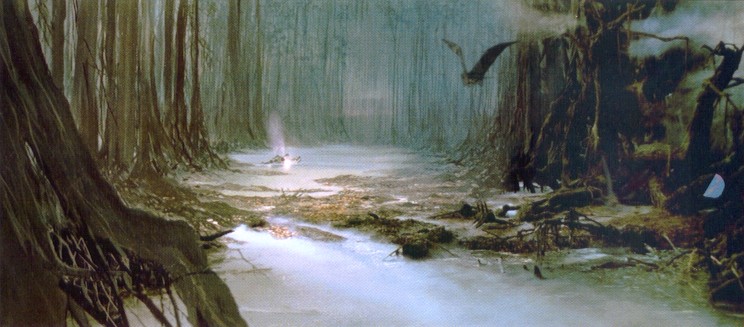
The Dagobah Swamp
SCENE 4: A young man, swamp-moss still clinging to his silk robe, runs through the crowd to the Teacher. He pants, out of breath—tearing himself from the mire had taken enormous effort. Teacher, he says, how do I inherit eternal life? “Ah, you wish to enter into life? Follow the rules: don’t kill or steal or cheat, love your neighbors and parents.” But, the man protests, have I not done all these things? What am I still lacking? The Teacher looks at the ridiculous figure in front of him: pudgy cheeks, designer robe, with mud caked on everything. And the Teacher loves him. With deep tenderness in his voice, the Teacher replies, “If you wish to be complete, go and sell all you possess. Leave your marsh-land and your marsh-palace and instead come, follow me.” The man’s face goes crestfallen. He slowly turns, and instead begins to trudge back to his pit. Once there, he eases himself into the ooze and cries bitterly, for he cannot part with his swamp!

Dénouement:
 “Truly I say to you, it is hard for a rich man to enter the kingdom of God.” A scary sentence if ever I’ve heard one. But maybe it makes sense. I see people around me trapped in the swamp of wealth, and I know that that’s not how God wants it. That’s not life. And if that’s the American dream, to have a big-screen TV, a big empty house, a big Louis Vitton bag, and a big fat entitled attitude to go with it all, then let’s leave the American dream behind. It is a trap; it is a lie.

If anyone, including me, begins to flounder in the swamp of wealth, may he, unlike the young man, have the courage to leave it. He who has ears to hear, let him hear. 

Saturday, March 17, 2012

Anakin Skywalker: Tatooine's Messiah

Star Wars is more than the sum of George Lucas’ films. The symbols, characters, and themes go beyond anything he could have dreamt up, intelligent as he is. They touch on lodestones in the human spirit, the stories that rise up in every religion, every culture, and every generation.

I’ve written elsewhere of Anakin Skywalker, the lynchpin to the whole saga. He is the one who rejects both the strict, unyielding dogmatism of the Jedi and the unrestrained evil of the Sith. He successfully treads the line between moralism and relativism. His ultimate, deepest motivation is love.

I did not make it explicit enough in my previous blog. In many ways, Anakin is like Jesus.

But my previous blog largely used evidence from Episodes 2 and 3; here, with the film fresh in my mind, I shall focus on Episode I: The Phantom Menace. Anakin, like Jesus, is a Messianic figure who must face down institutionalized injustice and slavery. And similar to Jesus in some of his dealings with Jewish religious leaders, Anakin is constrained by the Jedi, who forsake what’s actually right to follow arbitrary rules. Unlike Jesus, Anakin goes too far…but he’s still an incredible character. I don’t think the similarities are an accident.

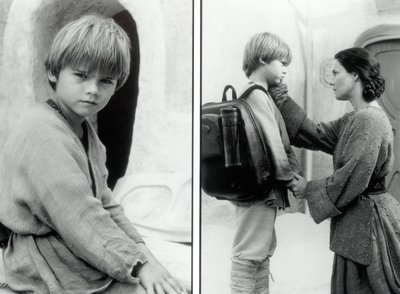
"I will become a Jedi, and I will come back and free you, Mom... I promise." -Anakin Skywalker
Social justice is a powerful theme in The Phantom Menace. From the opening scrawl, the viewer sees that the greedy capitalists in the Trade Federation are holding innocent Naboo hostage in protest against taxation. And what does the Republic do, as galactic protector? The Senate “endlessly debates.” Bureaucracy and regulations get in the way of true justice. Palpatine, the secret Sith Lord, says it best: “The Republic is not what it once was. The Senate is full of greedy, squabbling delegates who are only looking out for themselves and their home systems.  There is no interest in the common good...no civility, only politics...it’s disgusting…there is little chance the Senate will act on the invasion.”

In contrast, we have the Jedi! The guardians of peace and justice in the galaxy! Surely they can help! And indeed that’s how the Jedi are portrayed in much of the film, as well as the whole Star Wars saga. Qui-Gon Jinn and Obi-Wan Kenobi dispatch dozens of battle droids and help Padme Amidala navigate the treacherous Outer Rim so that she can make her plea to the Senate, and then go on to accompany her on a daring last-ditch effort to wrest Naboo back from the capitalists.

This is the view of the Jedi that Anakin Skywalker holds. Anakin is a slave, out of reach of the Republic. Unseen forces trap him: invisible detonators hidden within slaves’ bodies prohibit escape. But he hears of distant worlds, and has powerful dreams…Perhaps this is due to the Force in him. As his mother confesses to Qui-Gon, Anakin was the product of Virgin Birth: the Force conceived him, the Chosen One, to “bring balance to the Force.” He had more potential than the even Yoda. Why was he then born into a world of slavery? Why would the Force “waste” him in a dry and thirsty land, rather than birthing him into the center of the galaxy? He could have been born on Coruscant, have been found by the Jedi, trained, and developed…

Two theories. First, perhaps the evil Darth Sidious intentionally used his Force powers to create life, and he chose to create this vergence of the Force in a system (a) near to his home planet of Naboo and (b) with institutionalized slavery. He may have hoped that this would hopelessly corrupt the young person, making him an ideal candidate for Sith indoctrination later in life. This indeed was the case, as we see.
But alternatively, if we assume the Force, not Sidious, chose Anakin’s birthplace, then perhaps the Force wanted him to grow up a slave in order to learn to overcome challenges and to make wrongs right.

Perhaps the greatest evidence for the second view is the scene at the Skywalker dinner table. It’s so powerful:
“I was wondering something…you’re a Jedi Knight, aren’t you?” Here Anakin asks the question that’s been burning on his heart ever since he saw Qui-Gon.
Qui-Gon looks at him. “What makes you say that?”
“I saw your laser sword. Only Jedi carry that kind of a weapon.”
Now Qui-Gon puts on a poker face but grants a subtle smile. “Perhaps I killed a Jedi and took it from him.” He tests the boy.
“I don’t think so. No one can kill a Jedi Knight.” A sense of finality, as if the statement were too obvious.
But Qui-Gon’s gaze goes blank. “I wish that were so.” A pivotal moment; perhaps Qui-Gon is remembering other Jedi he’s lost. But more importantly, he may sense a foreshadowing of his approaching death at the hands of Darth Maul. Anakin has (unexpectedly) caught on to something…

But I digress; my main point in saying this is that Jedi are almost mythological to Anakin, the boy who believes in angels (“They live on the moons of Iego,” he tells Padme). They are omnipotent.

Most importantly, we see that for Anakin the Jedi are bringers of justice. In the most momentous lines of the scene, Anakin declares:
“I had a dream I was a Jedi. I came back here and freed all the slaves…have you come to free us?”
Qui-Gon starts, “No, I’m afraid not…” and pauses.
Anakin looks at him doubtfully. “I think you have…why else would you be here?”

There! That exchange! Anakin sees this mysterious Jedi as potentially the Messiah, the one to set the captives free, the one to overthrow the gang lords and slave masters, the one to break the chains of bondage! More importantly, Anakin hopes and dreams that he himself could perhaps be such a Messiah to his people.

"Are you sure about this? Trusting our fate to a boy we hardly know?" -Padme

Zoom out, fast forward. 30 C.E., in dusty, remote Nazareth, a woodworker stands up in the synagogue and unrolls the ancient scroll handed to him. “The Spirit of the Sovereign Lord is upon me, because he has anointed me to proclaim good news to the poor. He has sent me to proclaim freedom for the prisoners and recovery of sight for the blind, to set the oppressed free, to proclaim the Year of the Lord’s Favor.” He rolled up the scroll, sat down; all eyes were upon him. “Today this scripture is fulfilled in your hearing.”

Anakin and Jesus. Both are born into institutionalized oppression, whether it’s the Romans or the Hutts. Both see themselves as the fulfillment of a centuries-old prophecy. Both face opposition from reluctant families and disbelieving local neighbors. Both have early, miraculous victories: Jesus heals the sick, gives sight to the blind, and raises the dead; Anakin is the only human who can race podracers, and wins the Boonta Eve Podrace, becoming a hero to the entire slave population on Tatooine. Yet neither Jesus nor Anakin lead a popular revolution against the evil rulers.

But this is where Anakin’s case is different from that of Jesus. For although Jesus’ decision against violent revolution reflected his own values of unconditional love for all, Anakin had slightly different values. Unlike Jesus, Anakin wasn’t God; he didn’t have to be totally perfect and could have overthrown the government of Tatooine even if it took a few lives. After all, this would fulfill the prophecy and would be the right thing to do. The Force does not require exactly the same moral code that Jesus preached.

So why didn’t Anakin bring freedom to the captives, release for those in bondage, to proclaim the year of liberty? Because the Jedi co-opted him, grabbing him from his home planet while neglecting the fate of all those left behind, enslaved. Anakin is the movie’s moral compass and knows the right thing for the Jedi to do is to free the slaves—it’s a clear violation of Republic law, to which Tatooine is signatory. Yet the Jedi do things “by the book:” they grab him and take him in for their own training. Indoctrination. And even then? Masters Yoda and Mace Windu look down upon this boy who doesn’t fit their preconceptions of a proper Jedi. “I sense much fear in you.”  Anakin and his abilities are constantly put down, rather than encouraged: “The Council forbids me to train you.” “Stay in that cockpit [away from the battle]!” Poor Anakin only wants to help, but in the end, the Jedi way constrains and hampers him…

All of these elements play into Anakin’s eventual framework shift that leads him to embrace the Dark Side in Episodes II and III, as I wrote about in my previous blog. The Jedi have fallen so far that they ignore the plight of an entire planet caught in slavery. Anakin is born to deliver them from captivity, but the Jedi—the very ones who should care most—are the ones who whisk him away just as he begins his messianic path. In Episode II, when Anakin returns to Tatooine and sees that not only have slavery and violence grown worse, they’ve taken his mother’s life, he vows to never let this happen again. Thus, when in Episode III the Jedi threaten to keep him from saving Padme’s life (a future he recognizes, again, from his dreams), Anakin decides to oppose the Jedi and side with the Sith. Not out of selfishness! But because he loves her too much and can’t afford to let dusty Jedi philosophy get in the way of that. (Similarly, when Jesus told a lame man to stand up and pick up his mat, he was ordering someone to break the Sabbath. The Jewish laws had gotten in the way of doing good, and he did not hesitate to break them when that was the case. There are many more examples; you can find a few at this blog.)


Anakin is a flawed character, yet ultimately very similar to Jesus all the way from his Virgin Birth to his sacrificial death and reappearance to those he loved. I do not think George Lucas intentionally made Anakin like Jesus. I think he wrote a gorgeous, compelling narrative. However, to write a story that rings true to us, he reflexively drew upon the same themes that are present in every great story: love, justice, sacrifice, reconciliation, good vs. evil, pride vs. humility.

But these are not just ethereal ideas. I believe they entered into space and time, becoming concrete in the most beautiful, wonderful, and truest story of all human history. In this story, God loves us, and came to us. Desperate to lift us from the mud to glorious, meaningful, new lives, God made himself a lowly slave boy, caught under the heel of the most powerful Empire in human history. Jesus lived among humans, tracing a narrative arc that culminated in his ultimate sacrifice for our souls. Yet, just like Yoda, Obi-Wan, Qui-Gon, and Anakin (and Osiris, Odin, Bacchus, and other myths that approach the truth) death could not hold him down. He conquered death and offered new life to all who chose the Way of life, the Way of love. And that is what I believe. 

If any of this intrigues you, email or call me and let's talk. It's only the most important story ever told.  I'm not too surprised some of its themes made it into Star Wars too. 

Thursday, February 23, 2012

God and "The Pill"


Contraception has been in the news quite a lot lately, as the social conservative Rick Santorum tries to fight against front-runner Mitt Romney. According to Santorum,

“One of the things I will talk about, that no president has talked about before, is I think the dangers of contraception in this country. It's not okay. It's a license to do things in a sexual realm that is counter to how things are supposed to be.”

Now, Santorum is a Catholic, and Catholics traditionally hold much more conservative views on contraception than other Christians. I largely disagree with his view of contraception. However, there are some keys ways in which I think I could sympathize with his personal reluctance to use contraception.

Rick Santorum and his trademark sweater vest
But first, let me explain what we are and aren’t talking about today. We ARE talking about condoms, the Pill, and other methods that prevent sperm and egg from joining. We ARE NOT talking about abortion or abortifacients, which either kill the fertilized egg or prevent it from implanting into the uterus so that it dies, something most Christians do think is at least somewhat morally wrong. [However, to complicate matters for Christians, science shows that more than 50% of fertilized eggs fail to implant into the uterus or otherwise develop. Thus, God or Nature kills more than half of all the babies that are ever started—assuming you believe that an unimplanted, fertilized egg does indeed count as a baby. Maybe Plan B “abortion” pills that merely prevent implantation of a fertilized egg aren’t so morally bad after all! After all, that’s what happens more than 50% of the time due to natural causes….]

Also, while we ARE talking about contraception in moral terms, we ARE NOT talking about it in legal terms. Although Santorum thinks states should be allowed to ban the sale of contraception, even he doesn’t argue they actually should do so. He may personally think so, but probably realizes how controversial that would be. Thus my discussion today is purely on the moral status of contraceptives, from a Christian perspective.

Why exactly do Catholics such as Santorum think contraception’s so wrong? According to their logic, God commanded sex purely for the purpose of procreation. Thus, contraception is immoral because it means that sex would be only for fun without the possibility of having children.

This is completely wrong. While God does encourage childbearing, in the Bible there is a clear support for sex for many other reasons. Sex cements and reaffirms the covenant of marriage. Sex brings a union of male and female in a way that reflects the image of God (Genesis 1-2). Sex is to be practiced by both young and old, regardless of whether or not children are a possibility (Abraham & Sarah and Zechariah & Elizabeth are two couples who are still making love at 80+). Sexual desire is even made explicit in the Song of Songs, in which the lover describes his beloved’s breasts as perky “fawns, the twins of a gazelle.”

The one time contraception is described in the Bible, admittedly, it is described negatively: Onan “spilled his semen on the ground” in order to not impregnate his dead older brother’s wife (Genesis 38). God, out of anger, killed him. However the anger was due to his not fulfilling his duty to continue the line of the firstborn. Onan selfishly messed up the family tree. However, such guidelines are part of the Old Testament guidelines that the New Testament overrules: nowadays, if I had an older brother and he died, no church in the world would insist I impregnate his widow to continue his family line.

Thus, I am totally ok with the use of contraception in the context of marriage. It should definitely not be banned.

BUT! I do think there are some potential reasons that Christians may want to consider not using contraception, reasons that I have not yet really heard from Catholics.

First, contraception means Christians are less reliant on God in yet another area of their life. Already, technology and prosperity mean that most Americans can get along just fine without God. We do not need Him for our daily facebook, Internet, and cell phone service, let alone our daily bread. Contraception is just another area of claiming control over an area of life that God used to control: I’m going to decide when I get pregnant and when to have children. A choice to not use contraception in marriage might make a Christian depend more on God: life plans get disrupted, but that happened to the early Christians too. A life of radical discipleship requires the willingness to let go of our own plans and to willingly follow God in His.

Secondly, contraception limits family size. Having a larger family is very counter-cultural in the West; people think it’s too chaotic or costly. But in reality, cost per child goes down the more children you have: buying bulk foods makes more economic sense, hand-me-downs limit new shopping…the difference between having two children and three is really not that much. There’s a lot of joy in having a slightly bigger family, and stepping away from contraception might enable some Christian families to experience and be a witness to this in a radical and life-giving way. 

Thirdly, in the absence of contraceptives, couples can still practice the rhythm method of birth control: only having sex during the two weeks per month when the woman is not ovulating. While less effective than actual birth control, the rhythm method would have an interesting and really cool result in marriages. Couples would now have a time of rest, of Sabbath, of being apart, and then a better, more glorious joining together during the next two weeks. There’s this idea in American culture that sexual tension always has to be gotten rid of immediately, that we can’t live with it. I think that’s totally wrong, and thus part of why I’m living in that tension now. A time of tension can be very fruitful and productive. Couples would learn to appreciate each other, and sex, more.


In conclusion, where do I fall? I do think God gave us a ton of free will. That’s a separate blog, but something I believe very strongly in. I think he often gives us a large degree of complete freedom in choosing occupations, spouses, and whether to have children. Sometimes he might prefer one option over another, but other times the choice is entirely up to us. Thus I think I would affirm contraceptives for Christians who prayerfully choose that option. Perhaps they are missionaries in North Korea and cannot afford to have a kid, or perhaps they want to limit the environmental degradation to God’s creation that a large population causes. Whatever the case, if the issue is prayerfully and mutually decided upon in the context of marriage, I think they make the right choice.